
Rethinking Reverb’s feedback rituals
2023
Each year, Reverb runs an engagement survey to understand team sentiment. One issue that came up in Product was our feedback process. Designers didn’t always feel psychologically safe receiving feedback, especially from senior leadership, and often felt pressure to respond right away. The process itself was also pretty scattered, with a mix of ad hoc comments, async input, and too many meetings. That left designers feeling overwhelmed and unclear on next steps.
To address it, I led a full overhaul of the feedback process and created a more structured, clear system. Since then, it’s helped improve clarity, direction, and psychological safety across the team.
Taking inventory
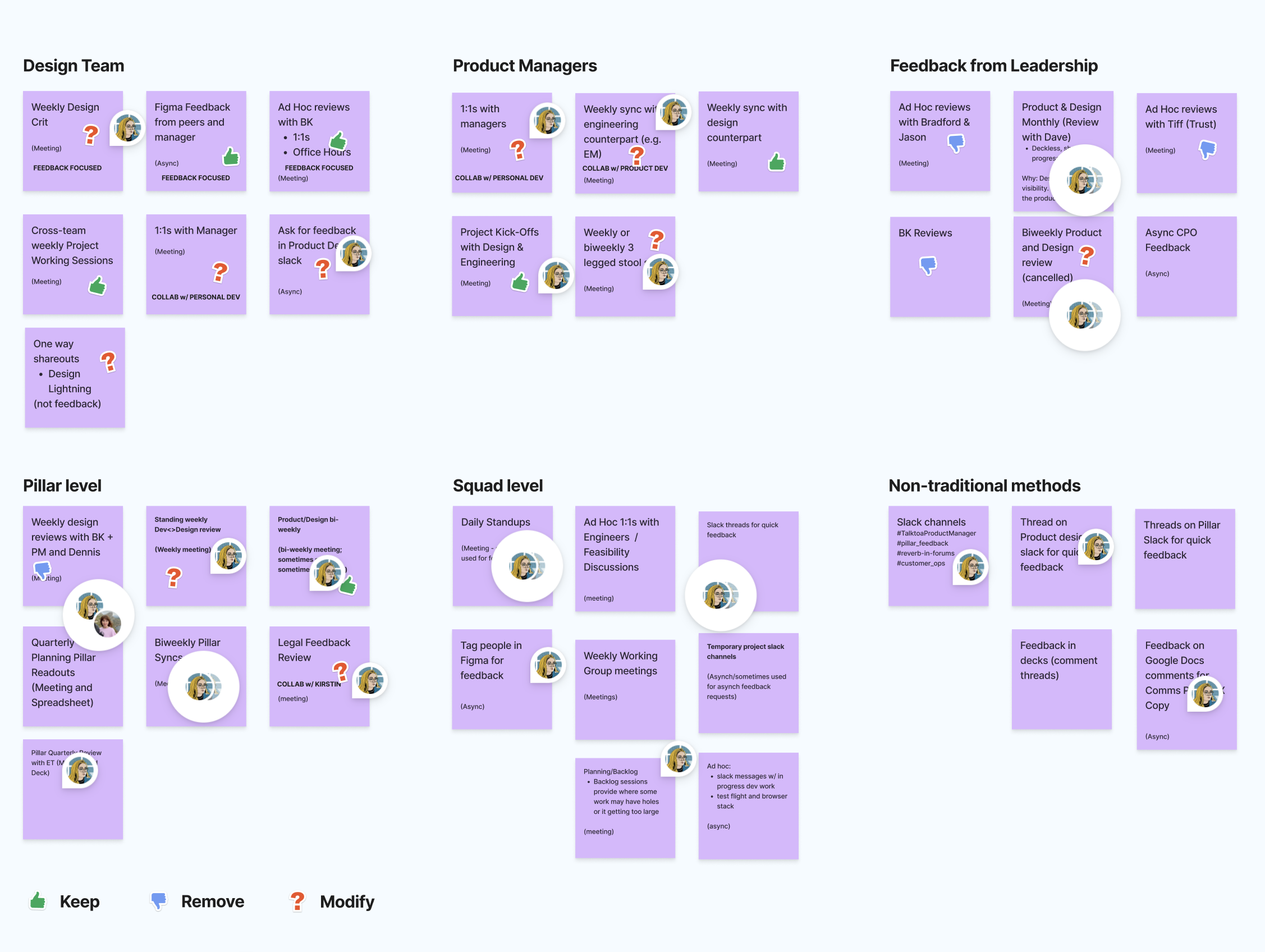
Before introducing a new process, I took stock of all the ways designers and PMs were getting feedback. Between the countless meetings, Slack messages, ad hoc comments, and other random methods, it took a few weeks and several team interviews to track everything down.
After the audit, I identified redundancies and looked for ways to reduce overlap. I organized everything by ritual type, then grouped each meeting or ritual into one of three categories: Keep, Modify, or Remove.
Redefining our rituals
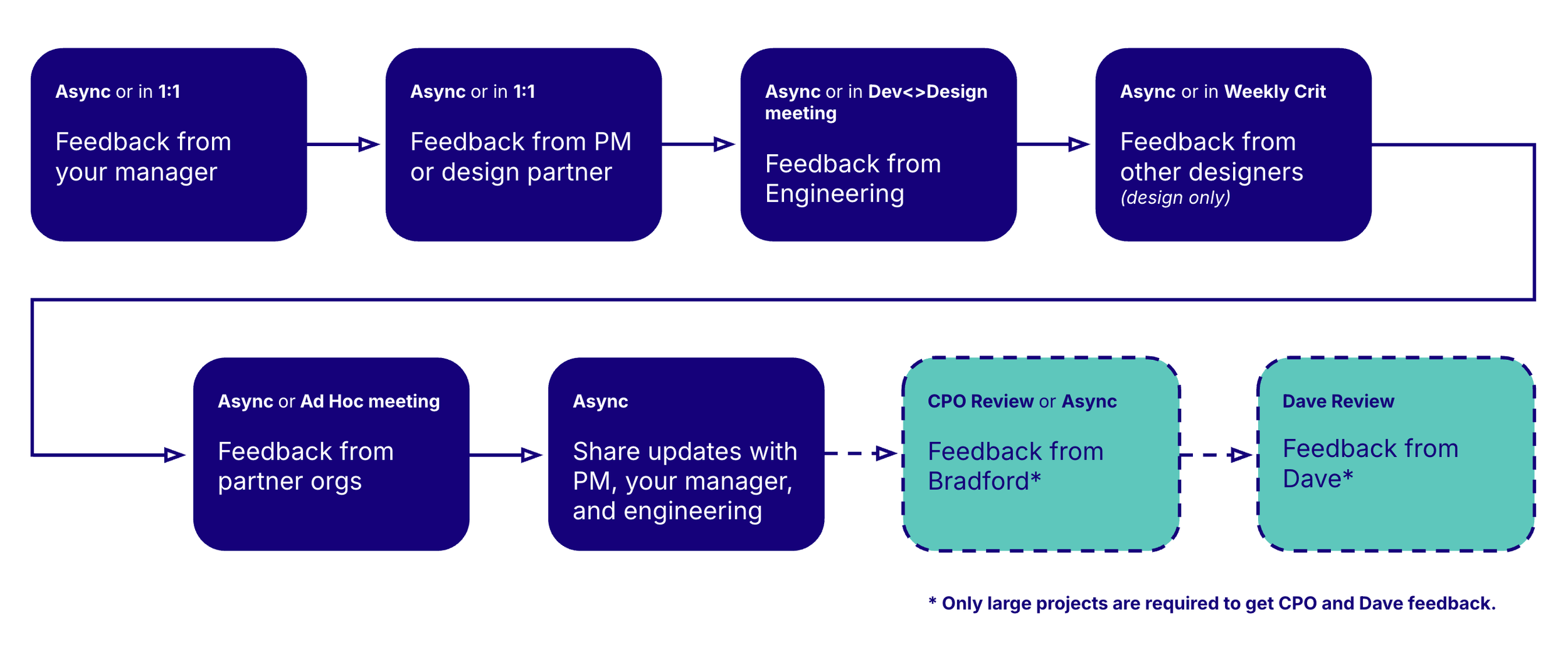
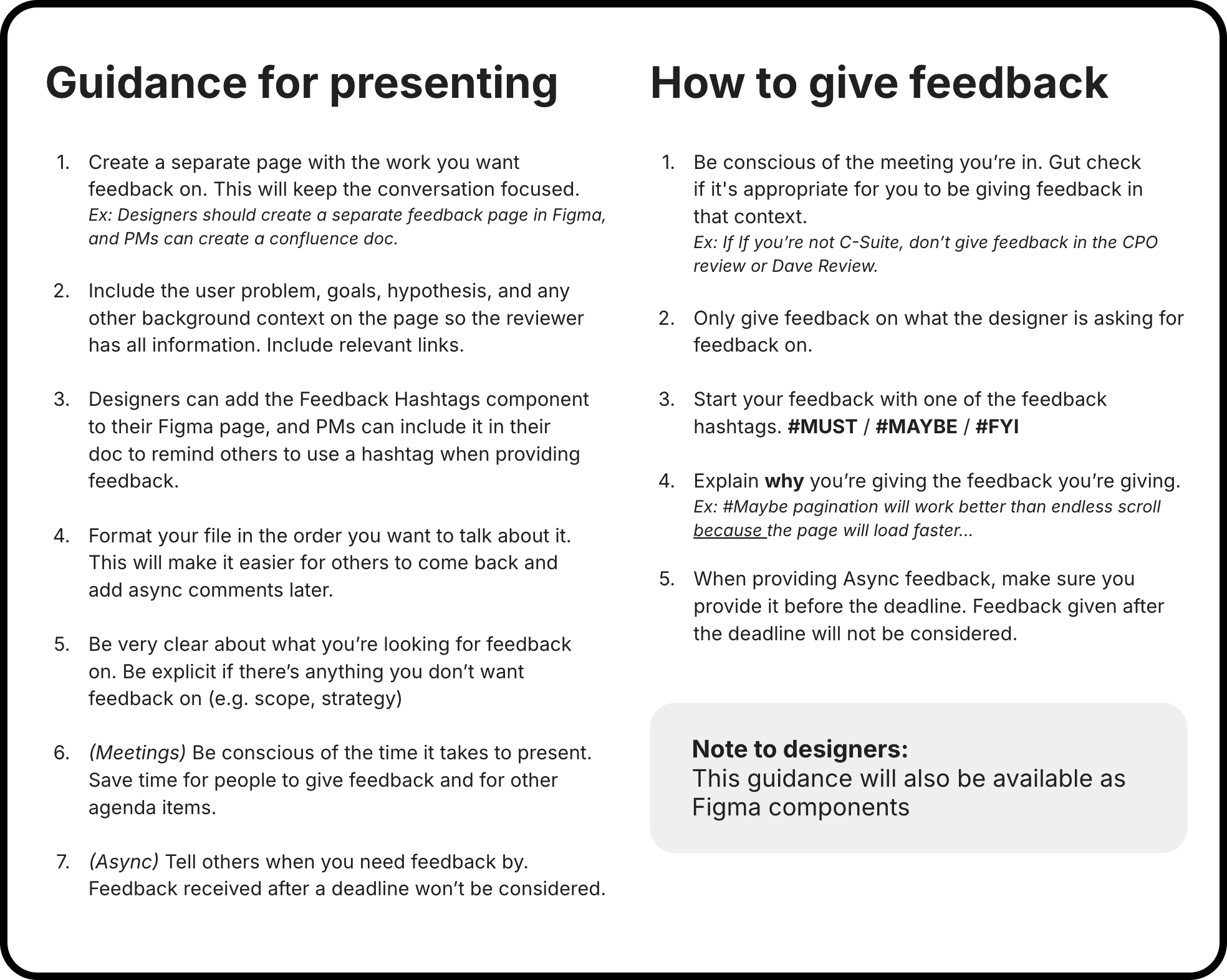
After analyzing the inventory, I designed a more structured feedback process with fewer, more purposeful meetings and clearer expectations for each. I also included guidance for presenters and feedback-givers so that each meeting would be more productive.
The meetings are:
Weekly Design Review: A weekly session where the entire design team gathers to review ongoing work, share progress, and get feedback from peers.
Cross-team project working session: A weekly session scheduled after a project kickoff. This meeting is needed when there's multiple teams or designers working on a single project. The purpose of this meeting is to provide status updates, make design decisions based on anything new that came up in the last week, and share in-progress work to get feedback from your design collaborators.
Weekly Design Review with Engineers: A squad-level, weekly sync between the designer and engineers to address feasibility and implementation.
Biweekly CPO Review: A focused meeting every two weeks to keep the CPO tuned-in to projects, ensure alignment on design direction, and get strategic feedback. Showing the CPO preflight work AHEAD of broader share outs ensured that he wouldn’t poke holes in the work in front of a broader audience and can advocate for the team in future feedback sessions
Quarterly CEO Review: A high-level review meeting with the CEO (Dave), held once a quarter, to give product designers visibility with the CEO, bring him into the product development process, and gather his feedback.
Three-legged Stool Meeting (PM, Designer, EM): A cross-functional meeting to ensure that product, design, and engineering are in alignment and working toward shared goals.
Reverb’s design feedback lifecycle
Guidance shared with the product org
Feedback hashtags
I also introduced a new way of giving feedback. Anyone sharing feedback with Product or Product Design had to use a hashtag first. The hashtags only applied to feedback, not questions. This made it much easier to prioritize input and quickly understand what needed action versus what was optional or just informative. It also helped designers feel more psychologically safe, since they no longer felt pressure to act on every comment right away.

There’s a commitment to explore and respond to this feedback. It must be incorporated or tried before progressing to the next step.
Example: #Must include XYZ legal text

This is a suggestion with no commitment to respond. It's okay for the work to progress without incorporating this feedback. Example: #Maybe try pagination instead of an endless scroll

This is something to be aware of. It does not necessarily facilitate an action. Example: #FYI Here’s a related article or learning related to the work
Results
Better engagement survey results
In our 2024 engagement survey, satisfaction with the feedback process improved significantly. There were no negative comments about feedback, and designers specifically called out how much they liked the new hashtags.
Improved clarity
The new meeting cadence and hashtag system made feedback easier to understand and act on.
Stronger cross-functional collaboration
The updated feedback process improved alignment across design, product, and engineering.
More psychological safety
Designers said they felt safer asking for feedback. The new system helped reduce the fear of being overwhelmed or judged, and the hashtags made it easier to understand what to prioritize.
Company-wide adoption
The CEO loved the hashtag system, and it was eventually adopted across the company. It turned out this kind of clear, prioritized feedback was useful far beyond Product